
Every RTO manager lands in the same spot eventually. An RTO website has two jobs — keep ASQA happy, and actually fill courses. Somewhere along the way the sector taught them those two jobs pull against each other.
A training manager put it to me better than I could last week. Her compliance was watertight: documentation done, trainer and assessor matrices done, policies and procedures brought back in line. What worried her was whether the website could stand on its own, attract a cold domestic audience, and convert them, without tripping a single ASQA requirement in the process.
That is the real problem in this sector. Not compliance on its own. Not marketing on its own. The gap between them, and the fact that almost nothing is built to close it.
The RTO website that looks fine and does nothing
Plenty of RTOs have a website. It sits there. It ticks the "everybody needs one" box. It doesn't book anyone, it doesn't take payment, and it doesn't feed a single field into your compliance.
Then a lead lands and the cracks show. The enrolment form lives somewhere else. The LLN check lives somewhere else again. USI verification is a manual job. Someone re-types the same student details into three systems, and every re-type is a place for an error to creep into your audit trail.
You can drive all the traffic in the world at a site like that. If a cold student can't book, apply, and pay in one go, the traffic leaks straight back out.
One system, inquiry to completion
RTO Grow runs the whole line, from the moment a student inquires to the moment they complete.
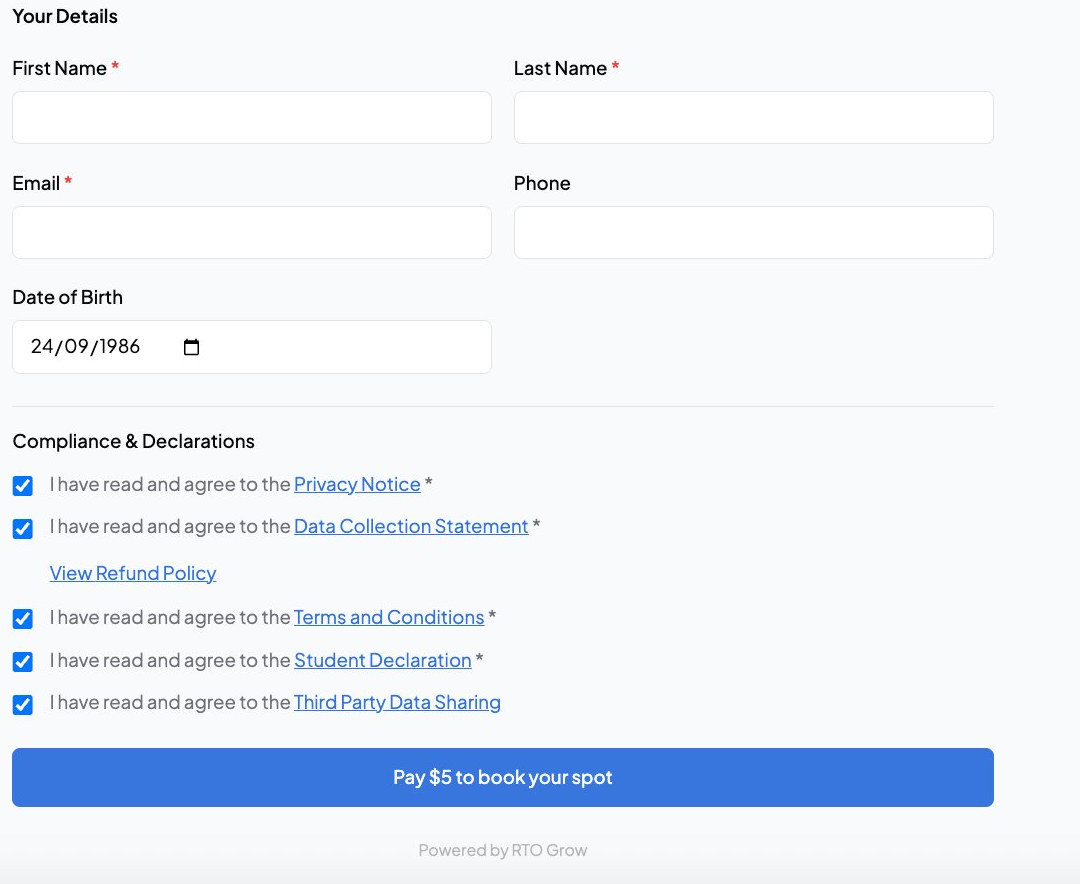
A student books and pays for their spot, and the enrolment form lands in front of them straight away. USI checking runs through the government API. The LLN indicator can serve contextualised questions per course, generated for you or written yourself, with a review step so a specialist signs off before anything goes live.
The part that saves RTO managers the most time is the boring part: you upload once, and it populates everywhere. Set up a course and those details flow into the TAS, the forms, the web page, and the landing page on their own. Change a policy in the clause library and it updates across every form and page at once. No double handling. No chasing the same information three times.
Compliance collected at source
Every action is logged as it happens, straight into a continuous improvement register and an evidence log. When an audit lands, or when you just want to review, you export the enrolment register, the payments, the trainer records, the lot, in one click, with attachments and PDFs sitting next to their entry in the file.
There is a finance ledger for who has paid and who is outstanding, employer invoicing for the RTOs running bulk training, and a website plugin that turns a proper RTO site with search and online booking into a one-day job instead of a six-week, several-thousand-dollar one.
The proof
One RTO came across to us recently after two months of trying to get seventeen units onto another platform. We migrated the lot in five days. Inside about two and a half weeks they had turned over more than $150,000, all of it on automated booking and payment, including bulk client enrolments, with AVETMISS reporting running underneath it.
That is the difference between a website that exists and a system that works.
On building your own
I understand the pull to build in-house. Every founder feels it at some point. But watch what happens next. The moment someone says "we're building our own," the honest worry sets in, because what tends to come back is highly compliant and painful to use. And the person stuck using it every day is the RTO manager.
Building it properly is a genuine cost. USI integration alone is a serious piece of work, before you touch data residency, payments, reporting, and the hundred small things that all have to sync. That is exactly why we built it once, kept the data in Australia, listed on the AVETMISS compliance register, and put a technical security specialist behind it, so you don't have to reinvent the wheel to run a modern RTO.
Have a look
You can set up a free account and build a full unit inside it before you decide anything. Import your units from training.gov.au, generate a learner guide from the elements and performance criteria, run a test enrolment end to end. If it isn't for you, export your work and go, no hard feelings.
Most RTO managers don't switch because they assume switching is a nightmare. This one isn't. That's the whole point.
Have a look at what it costs, or book a demo and we'll walk you through it on your own data.